P800 Refund

Independent UK guidance for P800 refunds and HMRC letters.

Official HMRC links matter. This site explains the process in plain English and points readers towards official GOV.UK routes.

Timing guide

When Will I Get My P800?

Updated for the 2025/26 tax year. Independent guide, not affiliated with HMRC or GOV.UK.

Quick answer

Most P800 letters for the 2025/26 tax year are sent between June 2026 and March 2027. We are now in the peak period — letters are being sent out daily. If you are expecting one, check your Personal Tax Account on GOV.UK for updates. Online refunds are usually paid within 5 working days.

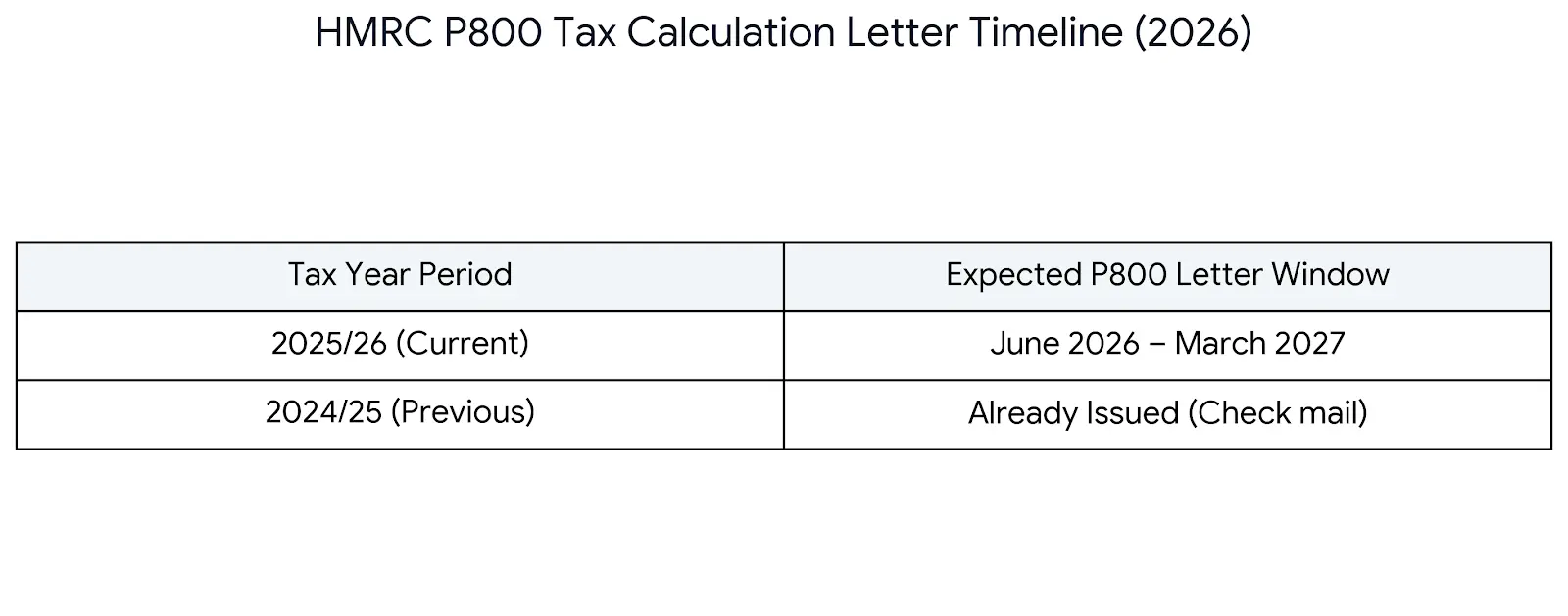
HMRC P800 tax calculation letter timeline for the 2025/26 tax year, showing letters issued from June 2026 to March 2027.
A simple timeline showing when HMRC usually sends P800 tax calculation letters for the 2025/26 tax year.

Is it normal if I have not received my P800 yet?

In July 2026: this is completely normal. Letters are being sent from June 2026 through March 2027, and most people receive theirs between June and October. If you have not received yours yet, it does not mean something has gone wrong — it means HMRC has not reached your case yet. Check your Personal Tax Account on GOV.UK for any updates.

HMRC confirmation (2 June 2026)

HMRC confirmed on social media: “We'll be automatically reviewing records for the last tax year shortly and we'll let you know if you've overpaid or underpaid tax from June onwards. We'll begin issuing tax calculations from June onwards, so if you owe tax or are due a refund, you can expect to receive one between then and March next year.”

Ready to claim your refund?

If your P800 shows an overpayment, you can start your claim online safely. Follow our step-by-step claim guide →

Readers often search for when P800 letters are issued, when P800s get sent out, and when they can expect a refund. HMRC says P800 tax calculation letters are usually sent between June and March of the following tax year, with many people receiving them between June and October.

If you are wondering when will I get my tax refund after claiming, the answer depends on your route: online refunds are usually paid within 5 working days, while cheques take longer. The timeline below explains each stage from tax year end to money in your account.

If you're new to P800 refunds, start with our P800 Refund Guide → for a plain English overview.

Current GOV.UK guidance says tax calculation letters are sent between June and March of the following tax year. HMRC confirmed on 2 June 2026 that letters are being issued from June onwards. If you are still waiting, that delay can be normal — it does not mean something has gone wrong.

HMRC timings can vary, so the aim here is to provide realistic expectations and the right next checks if you have been waiting longer than expected. It is more helpful as a guide to common timing patterns than as a promise of exact dates for every case, especially if you are comparing claim timing, cheque timing or the details on your P800 reference letter.
Letters sent: June 2026 - March 2027
Online claim (fastest): refund in about 5 working days
Cheque by phone request: up to 6 weeks

James Wells

Editor and fact-checker

Edited & fact-checked against official HMRC / GOV.UK guidance

Read our editorial policy

P800 Timeline: From Tax Year End to Money in Your Account

APRIL – MAY 2026

HMRC starts the clock

Tax year ends 5 April. Your employer sends P60 by 31 May. HMRC begins automatic reconciliation — no action needed from you yet. Most people won't hear anything in these months. If you haven't received your P60, ask your employer before contacting HMRC.

JUNE – OCTOBER 2026

Letters start arriving

This is when most P800 letters are sent. HMRC calculates everyone's Income Tax between June and November. If you have a Personal Tax Account, you may see a digital notification before the paper letter arrives. Simple cases (single job, no benefits) tend to be reviewed first.

NOVEMBER 2026 – MARCH 2027

Later letters and complex cases

If you had multiple jobs, changed employers, received benefits, or had pension income, your case may take longer. This doesn't mean something is wrong — it means HMRC needs more time to reconcile your records. Check your Personal Tax Account online if you want to see whether a calculation has been issued.

AFTER MARCH 2027

Still nothing? Here's what to do

If you haven't received a P800 by early 2027 but believe you overpaid tax, log into your Personal Tax Account on GOV.UK. You can also write to HMRC with details of your income and tax paid. Keep records of any correspondence dates — this helps if you need to follow up later.

2024/25 vs 2025/26: tax year timelines compared

P800 timing follows the same pattern every year, but the dates shift with each tax year. This side-by-side view helps you check whether your expectations match the current year.

Stage2024/25 tax year2025/26 tax year
Tax year ends5 April 20255 April 2026
P60 deadline31 May 202531 May 2026
P800 letters startJune 2025June 2026
Peak delivery windowJune–October 2025June–October 2026
Latest lettersMarch 2026March 2027

GOV.UK says tax calculation letters are sent between June and March of the following tax year. If you are comparing the two years, the pattern is the same — only the dates move forward by one year.

How long you might wait — by situation

Finding out when your P800 will arrive depends on what your tax records look like. The general window is June to March, but these common scenarios may give you a better idea.

One job, no extra income

Simpler cases are usually processed earlier, often between June and August. If your tax affairs are straightforward, you are likely to be near the start of the window.

Changed jobs during the year

HMRC may need more time to match records from different employers. These cases often land between September and November.

Savings interest or dividend income

Banks and providers report to HMRC on their own schedules, which can push a calculation later into the window.

Pension income alongside PAYE

Multiple income streams can take longer to reconcile. Some of these cases arrive between November and the following March.

The table below shows the published HMRC pattern for completed tax years. Because GOV.UK guidance has been consistent, the 2025/26 tax year is expected to follow the same pattern — from June 2026.

Tax yearFirst lettersPeak periodMain window
2022/23June 2023Aug–Oct 2023Jun 2023 – Mar 2024
2023/24June 2024Aug–Oct 2024Jun 2024 – Mar 2025
2024/25June 2025Aug–Oct 2025Jun 2025 – Mar 2026

HMRC says tax calculation letters for the 2025/26 tax year are expected from June 2026. The information above reflects the pattern GOV.UK has published for completed tax years, and the same timing structure is described in current HMRC guidance for the year ahead.

Typical timing after the tax year

Interest in P800 timing usually rises after the tax year ends because that is when people expect HMRC to review records and issue calculations. GOV.UK says tax calculation letters are sent between June and March of the following tax year, and the online tax calculation service says HMRC calculates everyone's Income Tax between June and November. If you need the wider background, start with the what your P800 letter means .

In July 2026, we are in the peak period. HMRC confirmed on 2 June 2026 that letters are being issued from June onwards. Most people receive their P800 between June and October. If you have not received yours yet, it does not mean something has gone wrong — it means HMRC has not reached your case yet.

Typical timeframes (2025/26 tax year)

Based on current GOV.UK guidance, these are the published timeframes HMRC gives for common P800 repayment routes. If you are comparing online claim timing with your own letter, the online claim guide explains the same routes in more detail.

These timeframes are useful as a benchmark, but your own case may still take longer if HMRC needs further checks or if your letter gives a different instruction.

  • Online claim (bank transfer): usually paid within 5 working days.
  • Cheque requested by phone: can take up to 6 weeks.
  • If your letter says HMRC will send a cheque automatically (limited cases): it should usually arrive within 14 days of the letter date.

Why some people wait longer

Timing can vary because tax records, multiple sources of income, identity checks or other administrative details may need more time. That is why one person may receive a calculation earlier than someone with a more complex record. If you are still unsure what the document means, review What Is a P800? alongside this timing page.

It can also depend on what happened during the tax year. A straightforward employment record may be easier to review than a record involving several changes or updated information arriving later.

  • Your tax record may be more complex than someone else's.
  • HMRC may still be updating information from employers or pension providers.
  • You may need to claim online — HMRC no longer sends automatic cheques in most cases.

What happens after you claim

If you claim online, your refund is usually paid within 5 working days. If you request a cheque by contacting HMRC, it can take up to 6 weeks. Keep a note of the day you claimed and any confirmation you received at the time.

If you have not claimed yet, use the claim route guide before comparing timeframes.

If your refund seems delayed

If you believe you should already have heard from HMRC, review the official route again, check the tax year you are waiting on, and keep a note of any claim or correspondence dates. That makes it easier to understand what stage you are at. If you are worried about copied refund links while you wait, use the official GOV.UK route guide before doing anything else.

The best first response is usually to gather the facts rather than guess. Confirm the year, confirm whether you already made a claim, and confirm that you are comparing your case with the right stage of the process. Remember: HMRC no longer sends automatic cheques in most cases, so you need to claim online or contact them by phone.

Where to go next

Need to double-check a suspicious refund message while you wait?

If you receive an unexpected text, email or WhatsApp message about a P800 refund while you are waiting, treat it carefully. GOV.UK says HMRC will never send notifications of a tax rebate or ask you to disclose personal or payment information by text message.

Sources

These pages are based on current official guidance and should be checked again if HMRC or GOV.UK updates the process.

Common questions

When can I expect to receive my P800?

HMRC says P800 tax calculation letters are usually sent between June 2026 and March 2027 for the 2025/26 tax year. Many people receive them earlier in that window, but some cases take longer. If you have already received your letter, you can claim your refund online here.

Where is my P800 letter? I have not received it yet

In July 2026, this is completely normal. Letters are being sent from June 2026 through March 2027. Most people receive theirs between June and October. Check your Personal Tax Account on GOV.UK for updates. If you still have nothing by October, contact HMRC.

When can I expect my HMRC tax refund?

Online refunds are usually paid within 5 working days. If you request a cheque by phone, it can take up to 6 weeks. HMRC stopped sending automatic cheques for most cases from 31 May 2024 — you now need to claim online or contact HMRC.

How long does a refund take after a claim?

GOV.UK says online claims are usually paid within 5 working days, while cheques requested by phone can take up to 6 weeks. If your letter says HMRC will send a cheque automatically (limited cases only), it should usually arrive within 14 days of the letter date. If you have not claimed yet, follow our step-by-step claim guide.

When are P800 letters usually sent?

GOV.UK says tax calculation letters are sent between June and March of the following tax year. For the 2025/26 tax year, HMRC confirmed on 2 June 2026 that letters are being issued from June 2026 onwards.

What if I have been waiting longer than expected?

Check tax year → confirm claim status → review Personal Tax Account → contact HMRC if needed.

Does everyone get a P800 at the same time?

No. Timing can vary, so different readers may hear from HMRC at different stages depending on their records and circumstances.

HMRC stopped sending automatic cheques — is that true?

Yes. Since 31 May 2024, HMRC no longer sends automatic refund cheques in most cases. You now need to claim online (5 working days) or contact HMRC by phone to request a cheque (up to 6 weeks). Automatic cheques are only sent in limited situations: multiple tax years involved, tax years other than 2023/24, repayments to a nominee, or if HMRC knows you lack capacity.

I haven't received my P800 in July 2026 — is that normal?

Yes, this is normal. HMRC sends P800 letters between June 2026 and March 2027. Most people receive theirs between June and October. Simple cases (single job, no benefits) tend to be processed first. If you changed jobs, have multiple income sources, or receive benefits, your case may take longer. Check your Personal Tax Account on GOV.UK for updates, or see our P800 notice guide for how to confirm whether one was issued to you.

Last updated: 10 July 2026 · Reviewed by James Wells

About the author: James Wells is the founder of P800 Refund. He started this site after receiving his own confusing P800 letter. All content is checked against current GOV.UK and HMRC guidance. Learn more →